When you picture the ideal manufacturing Chief Executive Officer (CEO) from a decade ago, you probably see them running the plant floor. They optimized production schedules, managed supply chains, and squeezed margins to ensure efficient and safe operations.
While those skills still matter for industrial companies, they’re no longer enough for modern manufacturing executives. Automation, AI, workforce shortages, sustainability regulations, and global supply chain volatility have reshaped the industry. An operationally focused leader without strategic vision fine-tunes what already exists but doesn’t anticipate what’s next. They keep your company running in one place.
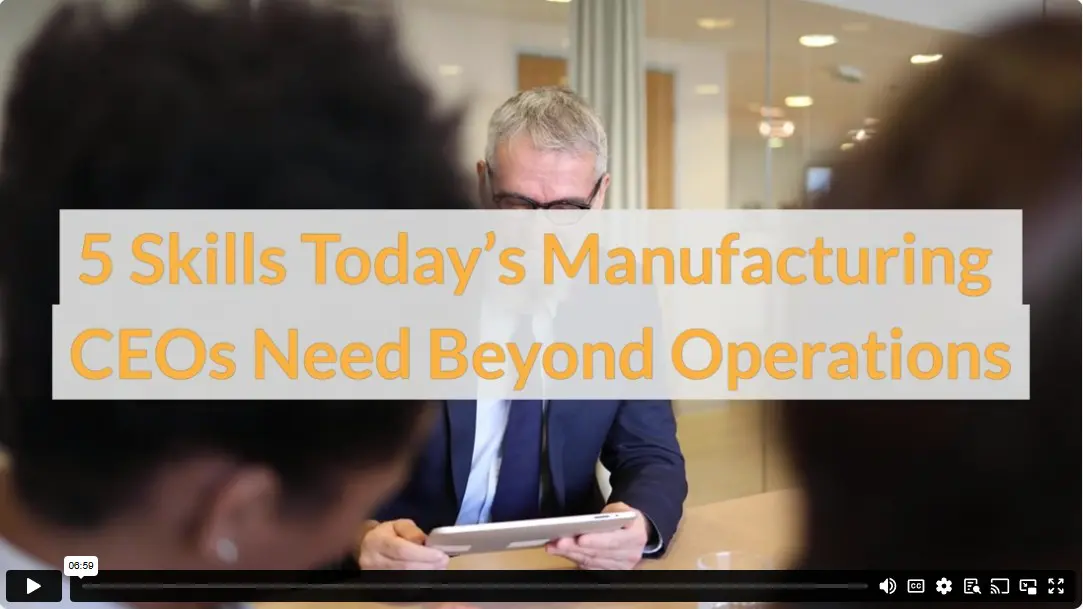
Leadership has to change with the industry. As an executive search firm specializing in manufacturing, we’ve learned that CEO’s who thrive in today’s market bring a broad range of competencies to the table, including these five skills.
1. Thinking Strategically About Technology
Manufacturing technology evolves quickly. AI-driven systems update their algorithm every week. Robotics labs continuously improve their materials and processes. And while your company doesn’t need to redo its systems every year, this technology is the future.
And you need your senior leader to navigate that future. A tech-aware CEO follows innovation trends closely enough to determine which products you should ignore and which you should invest in. They might push for greater data visibility across the supply chain, recognizing that this information reveals key opportunities for growth.
A modern CEO understands technology well enough to ask the right questions and connect it to operational problems. If you face consistent bottlenecks at your manufacturing plant, your top executive might ask the IT department to investigate where automation could improve the system.
You don’t need a leader to replace your Chief Technology Officer (CTO), but a modern CEO can think strategically about technology as part of a broader company plan. And with this fluency, your company can produce faster and smarter than the competition.
2. Understanding Manufacturing Finances
The executive leading your manufacturing company decides how to allocate capital for a profitable operation. Someone who has to wait until the quarterly reports to understand your financial state will always be reacting to circumstances.
Modern CEOs understand how money actually moves through manufacturing businesses. They know your margins by product, customer, and job, so you’re not chasing unprofitable revenue streams. They stay on top of cash flow to maintain financial stability. When these CEOs read the quarterly report, they’re not surprised. They’re double-checking to make sure they haven’t missed anything.
A financially sharp CEO also builds income awareness across C-level leadership. When the second-in-command, Chief Marketing Officer (CMO), head of sales, and CTO make decisions based on real costs and profits, everyone can make smarter capital investments. And it spreads the burden of the bottom line from just the finance team or CEO to all your executives, supporting long-term profitability.
3. Leading People Before Processes
Manufacturing has shifted from needing more people to needing the right people. Workers with the necessary skills are hard to find and retain. The labor force expects higher compensation, better working conditions, more flexibility, and greater career opportunities. And those expectations allow other industries to recruit the best manufacturing executives.
Modern manufacturing CEOs need the skills to build and retain a strong workforce despite these challenges. This people-focused approach starts with basic leadership skills for understanding and connecting with people. CEO recruiters recommend clear communication, active listening, conflict management, meaningful delegation, and consistent accountability as baseline competencies for your top executive.
But senior leaders in manufacturing need to transform those skills into company-wide initiatives and culture shifts to counteract the industry’s current issues. These CEOs invest in professional development, create advancement pathways, connect roles to a purpose, and prioritize people over production.
Your operations might rely on processes and your revenue on production, but the whole company runs on people. Your CEO should recognize that the people running your machines and managing your lines are the backbone of the business, and lead with a human-first approach.
4. Driving Culture as a Business Strategy
Like people, culture in manufacturing companies often gets treated as an afterthought compared to output, safety metrics, and cost per unit. But a strong company culture actually drives all of those numbers.
Connecting your teams’ roles and efforts to a larger purpose increases accountability. And when all your employees take responsibility for their own work, overall safety improves. So does efficiency and output.
Imagine a CEO who:
- Drops in on safety committee meetings
- Goes beyond reporting production numbers and shares testimonials from end-users whose lives are better because of your company’s products
- Moves out of the boardroom to walk the shop floor and connect with workers
When recruiting C-level executives, a culture-focused CEO should pay special attention to how applicants share your values and purpose. They should be building a cohesive team with a passion for what your business is all about and where it’s headed.
Manufacturing may have had a reputation for a cold, production-focused environment. Still, modern manufacturing CEOs strategically drive a purposeful, collaborative culture to build a company that performs better at every level.
5. Navigating Diverse Contexts
Regulatory compliance, sustainability reporting, global trade dynamics, investor relations, and digital transformation all land on your CEO’s desk. And these issues require your top leader to step off the production floor to collaborate with board members, investors, government agencies, and overseas partners. The current complexity in manufacturing requires CEOs who can navigate diverse situations.
Contextually intelligent CEOs know how to behave, communicate, and make decisions depending on the environment they are in. Say you’re expanding production into a new international market. An adaptable leader can connect with local governments, outline operational challenges to their internal team, highlight the opportunities for their investors, and balance these diverse interests to direct the expansion.
Complex manufacturing situations move leaders out of the factory and require much more than operational skills. It takes a well-rounded, competent CEO with executive presence, situational awareness, and versatility to navigate diverse industrial contexts.
Building for the Future
Manufacturing is evolving, and your CEO needs to keep pace. Think of it like a treadmill. If your CEO stands still, they’ll move backward and fall off. You need a dynamic CEO who will quicken your company’s pace so you can get ahead.
CEOs still need to deal with operational groundwork, but there’s so much more. Modern CEOs must have the cultural leadership, technological awareness, people-first leadership, financial acumen, and contextual intelligence to drive your company into the future.
Video
Infographic
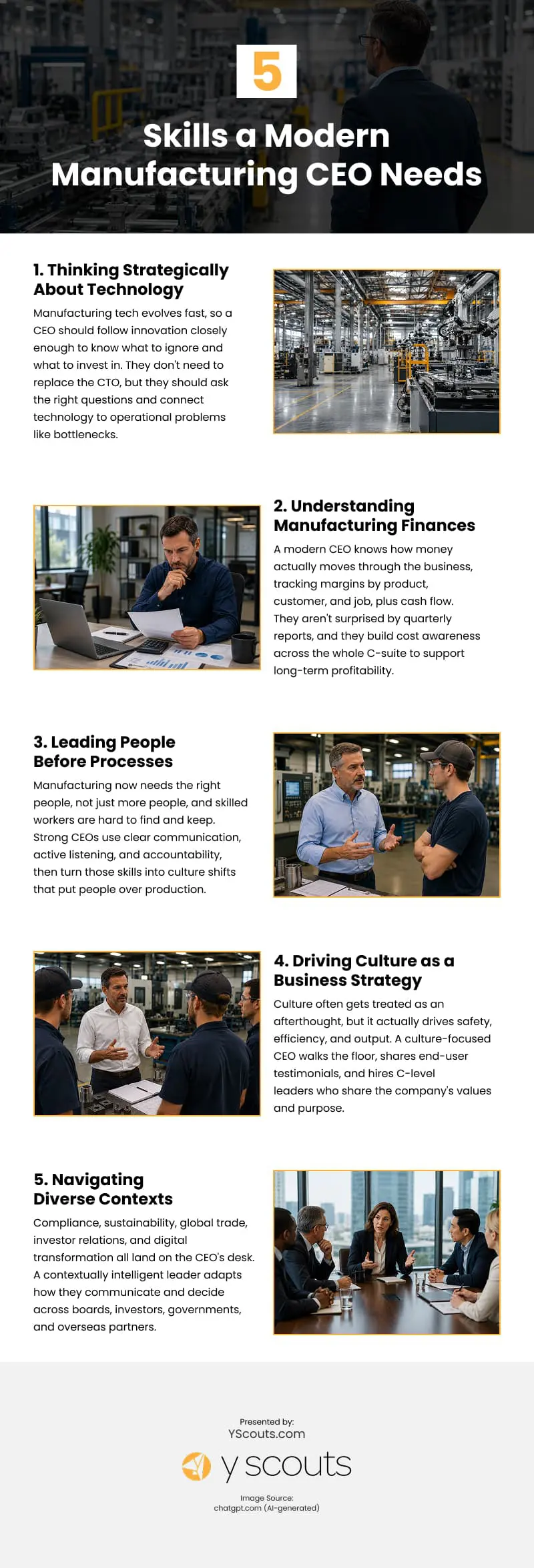
Leadership must evolve with the industry, and today’s manufacturing CEOs succeed by bringing a wide range of modern competencies to the table. This infographic highlights the key skills a manufacturing CEO needs to thrive in today’s market.