Ranges are set before the market moves
Almost every range is set carefully and in good faith. It comes from what the last person in the seat was paid, or from a budget built two years ago, or from a thoughtful read of what a company your size should pay for the work. What changes is the market around it, usually faster than anyone plans for, and that is less a planning failure than the nature of hiring senior people in a market that reprices every few months. The useful news is that it can be seen coming. A short look at what people doing this job are being paid right now, before the search opens, tells you whether the range will hold.
When that look does not happen, the gap tends to show up in week nine instead, when you are sitting across from someone your team has spent three months getting excited about and the number in hand is $30,000 light. At that point there are two moves left, and both of them tend to lose the hire. You can stretch the base by a few thousand dollars, which mostly tells the candidate that the ceiling is real and close. Or you can promise to revisit pay at the first review, which sounds reasonable in the room and sounds like nothing once they are home comparing offers, because a promise with no date, no dollar figure and no criteria is not something anyone can put on a spreadsheet.
The companies that win these hires do the work at the other end. They find the gap at kickoff, when there is still time to build something around it, and they walk into the offer conversation with a package instead of a number. That preparation is a large part of what Y Scouts does on a search, and it belongs in the first week rather than the week an offer is being drafted.

The three questions to answer at kickoff
These are the three we work through with you in the kickoff, before the first candidate conversation. First, where does this range actually sit against the market for this title, in this industry, at this company size? We will bring what we are seeing in comparable searches, and we will say the number out loud even when it is uncomfortable, because a gap you have named is a gap you can design around and a gap nobody has named will surface as a surprise in the worst week of the search.
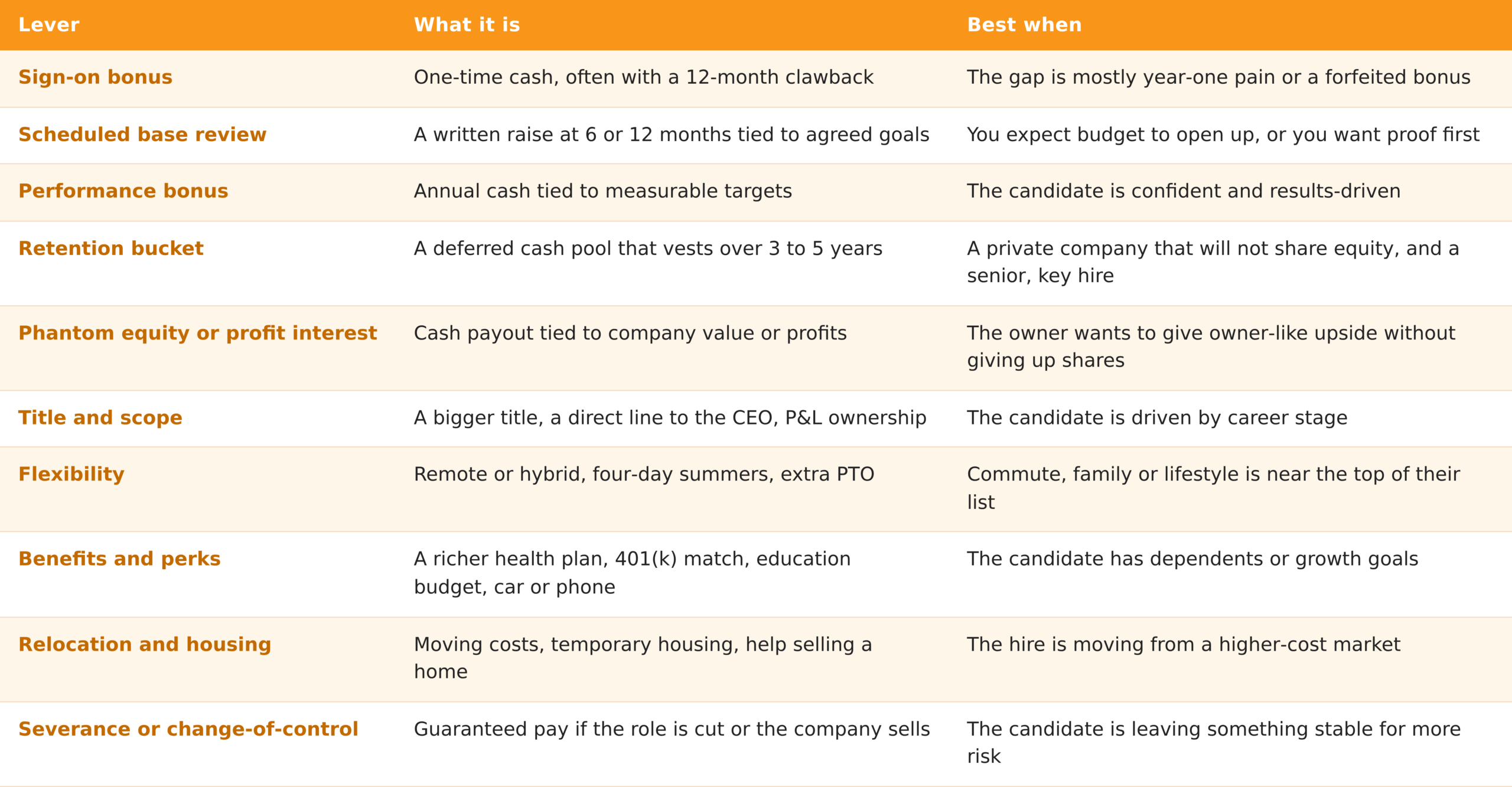
Second, if the base cannot move, what else can? This is the question almost nobody asks in a kickoff meeting, and it is the one that decides whether you have room later. Base salary happens to be the hardest thing for you to change and the easiest thing for a competitor to beat. Everything else in a package, the cash up front, the money tied to results, the money that builds if they stay, is yours to design, and most of it costs nothing in year one.
Third, what would it cost you to lose this hire, or to run this search twice? Count the fee, the months the seat sits empty, and the decisions nobody makes while it is. That number is the honest budget for everything in the rest of this piece, and it is almost always bigger than the gap you are trying to close.
The levers to build into the budget now
There are more of these than most owners realize, and the point of walking through them at kickoff rather than at offer is that several take time to set up. A retention pool needs your CPA. A written review schedule needs someone to agree the criteria. A relocation package needs a number. None of that happens in the forty-eight hours between a verbal and a signature, so we will ask you which of these are live and how big each one can be, and then we can give candidates real answers when they ask.
The bucket, and why it beats equity
The lever most owners have never used is the one that tends to do the most work, so it is worth spending a minute on. A bucket is a pool of deferred cash set aside for one key person, tied to time and to goals, that they collect by staying and delivering. It is a golden handcuff built out of cash rather than ownership, and the idea comes from Rich Monaghan’s book Buckets, which argues that the training and exposure that make a key employee great are the same things that make them able to leave, so the plan that keeps them has to be built on purpose rather than assumed.
Equity is the reflex answer for a senior hire, and for a privately held company it is usually the wrong one. Splitting ownership tends to breed arguments about valuation, jealousy among the people who did not get any, and resentment when the numbers do not move the way anyone hoped, and it leaves the employee holding something they cannot sell and cannot value. A vested cash pool gives them the same thing they were actually asking for, which is a stake in what they build, without handing over a share of the company or a seat in decisions the owner wants to keep.
The part that makes a bucket work is what it is tied to. Money that shows up simply because three years passed is a retirement plan. Money that shows up because they hit the targets they signed up for, and stayed to see them through, feels earned, and a candidate who believes they can hit those targets will value it far more than the same dollars handed over as base. That is also why the bucket should map to something real in their life. Someone saving for a house in four years and someone funding college in eight want very different vesting schedules, and you only find that out by asking.
Owner’s math
Here is the strange part, and it is the reason this approach works even at companies that swear the budget is closed. An owner who will not add $30,000 to a base salary will often fund a conditional pool worth several times that, because the two numbers feel completely different from the owner’s chair.
A raise is permanent, unconditional and compounding. Say yes once and you have said yes every year after that, whether the person delivers or not, and you have reset the floor for the next person in that seat. Deferred, conditional money is the opposite. It is paid later, out of results that have already shown up, and if the hire does not work out you have not paid it. Monaghan calls this owner’s math, and the practical version is that owners who balk at ten percent will commit forty or fifty percent more when the money is tied to time and performance, because the risk sits where it belongs.
This is why the third kickoff question matters so much. Once the cost of losing the hire is on the table as a real number, a conditional pool stops looking like generosity and starts looking like insurance, and the conversation moves from what you can afford to what you are already risking.
Ask these all the way through, not at the end
The lever that closes one candidate is noise to the next one, so the package has to be built around the person, and nobody can build it around someone they met last week. These are the questions we work into the process from the first real conversation onward, and we bring the answers back to you, so that by the time an offer is being drafted you already know which levers matter to the person you are about to hire.
- Beyond base, what would make this a clear yes for you?
- What are you saving or planning for over the next three to five years?
- What are you walking away from: a bonus, unvested equity, a 401(k) match?
- How do you weigh cash today against a bigger payout for staying and delivering?
- What would make you feel like an owner here?
- Rank these for me: pay, title, flexibility, growth, stability.
The last one is the most useful and the most often skipped. A candidate who ranks flexibility above pay has just told you that four-day summers and a home office budget are worth more to them than the $30,000 you do not have, and a candidate who ranks stability first has told you to put severance on the table.
Model the package before the first interview
We will build this table with you at kickoff, with real numbers, before anyone has a candidate to argue about. It takes half an hour, it tells us immediately whether the levers you have are big enough to cover the gap, and it turns a vague intention to get creative into something you can actually offer.
Here is what it looks like for a role sitting about $30,000 below market, with a sign-on covering year one, a written review at twelve months, and a bucket that vests at year three.
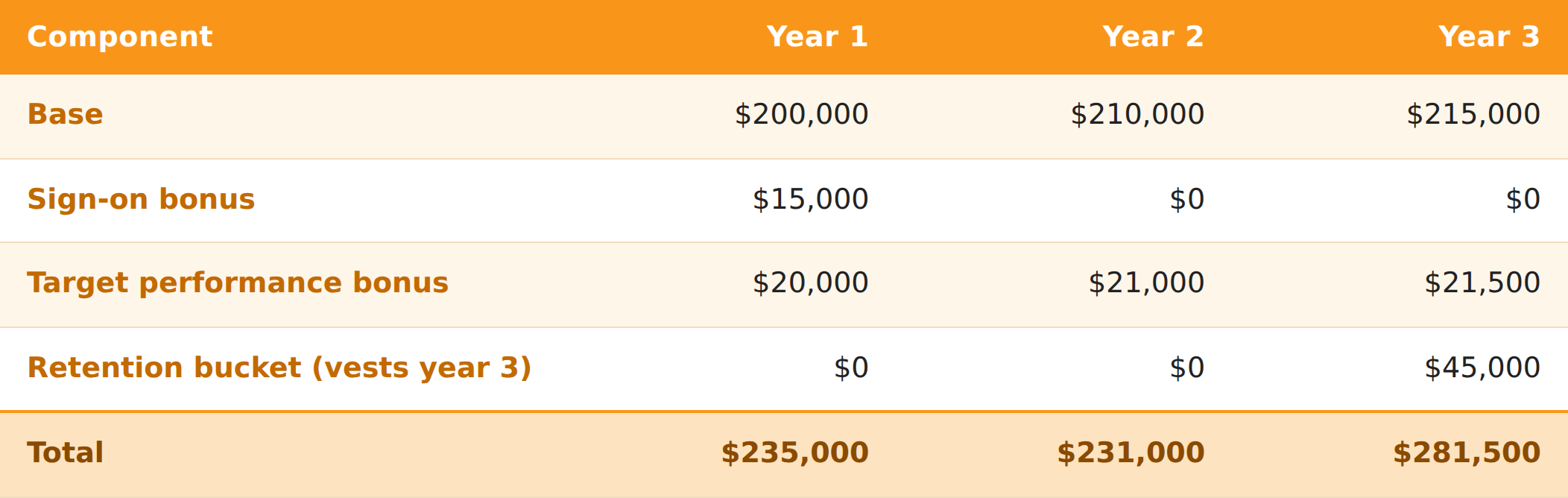
A candidate holding out for $230,000 in base is now looking at $235,000 in year one and $281,500 in year three, and the conversation has moved from what they are worth today to what staying is worth. Present it this way when the time comes, year by year rather than base with a list of extras underneath, because a candidate comparing two offers will compare whatever you hand them.
Four ways this goes wrong
Every one of these is recoverable if you see it coming, and expensive if you do not.
Deferred money is not worth the same as base, and selling it as though it were will cost you trust at exactly the wrong moment. A dollar three years out, conditional on targets and on the company still being there, is worth less to the person receiving it than a dollar in next month’s paycheck, and candidates know this. Present it as what it is, which is real money with strings, and let the size of it do the persuading.
Everything goes in the offer letter, in dollars, with dates and conditions. A review you plan to have at twelve months is a sentence in the letter naming the month and the criteria. A bucket is a schedule. Anything that lives only in the memory of a conversation will be remembered differently by the two people who had it.
Deferred compensation and phantom equity carry real tax and legal rules, and the client’s CPA and attorney design them, not us and not the hiring manager. Our job is to get the structure on the table early enough that the right people have time to build it properly.
Last, check the package against the team the person is joining. A creative offer that quietly pays the new hire more than the people who have been there four years solves one problem and starts another, usually about six months later.
Start here on the next search
The companies that lose senior hires over $30,000 are rarely the ones that could not find the money. They are the ones that only had one way to offer it, and ran out of room in the one conversation where running out of room is fatal.
So we put three things in the kickoff instead. We check the range against what the market is paying and tell you plainly whether it is short. We work out with you which levers are live and how big each one can be, and if a deferred pool is one of them, we ask you to bring your CPA in that week rather than in week nine. Then we build the year-by-year table with the numbers you have, so you can see the package the way a candidate will.
If you are scoping a search and the range feels tight, that is the conversation to have with us now, while every option is still open.