Changing the leadership at the top of your consumer brand should be seamless, right? Your organization can keep moving because you have a new executive ready to step in and a transition plan to ease their way. It looks like smooth sailing on the surface.
But changing C-level leadership is too often like throwing a rock into a pond. After the initial splash, the disruption quietly spreads across the entire pool. It affects your organization and your brand. Here’s how.

Slower Decision Making
Your teams’ successes often rely on their working relationships with your leaders. When a leader changes, everything resets. Teams need to learn how your executive thinks, what they value, how to get answers quickly, and what situations require escalation. You may expect your organization to perform at its prior level, but the end of your new hire’s onboarding period is really the beginning of the learning curve for your teams.
This adjustment phase significantly slows decisions and output across your brand. Teams that have been operating smoothly suddenly have new questions about product standards, priorities, sign-offs, and authority, and they wait for clarity before acting. Your C-team spends more time troubleshooting and explaining until everyone can get on the same page.
Onboarding may end after a few months, but your company may feel slow and sluggish for a year or more as the leadership changes ripple through your decision-making process. This can be challenging for consumer brands trying to stay relevant amidst rapidly shifting market dynamics. A lack of agility can hurt your competitive edge.
Cross-Functional Misalignment
Consumer brands depend on tight coordination between their different departments. The marketing, product, go-to-market, development, and customer experience teams have to move in the same direction, on the same timeline, and toward the same consumer to be successful.
When a leadership change disrupts any part of that alignment, the others feel it. The result is usually a series of small misalignments that compound over time. Your marketing team might have to scale back a campaign due to lack of resources, or your product team might delay a launch while waiting for a sign-off on their budget.
This misalignment happens in consumer brands because cross-functional collaboration usually relies on informal authority. Your department heads establish working norms governing which decisions need cross-functional input, how to get that input, and how to navigate bottlenecks.
Most new leaders inherit versions of those norms without the relationships or context to make them work, regardless of their expertise. A better executive search with the help of a seasoned C-suite recruiter considers how candidates fit into your existing system and eases them into the working environment. Because while none of these cross-functional challenges is a catastrophe in itself, each one costs you momentum and consistency.
Brand Inconsistency
You built your consumer brand on consistency. Your brand voice, visual identity, and customer experience need to work together across different departments. And while a style guide can support that consistency, it’s your leader’s decisions that determine whether the brand is cohesive or disjointed.
A leadership transition puts pressure on this consistency. A new executive adds a different perspective on what the brand should stand for and how it should represent itself. That’s often a healthy disruption. But even minor differences in instinct or approach can create inconsistencies in your campaigns, product positioning, and retail execution.
These impacts are often subtle. A campaign takes a different tone than previous work. A product launch gets repositioned after development is underway. A retail partner presents your product differently. These small shifts make the brand feel less cohesive and less familiar to consumers.
Customers may never know about your leadership transition, but they notice and judge the changes that rippled outward to your brand. And since you build consumer trust through repetition and familiarity, these periods of uncertainty can be costly.
Employee Confidence and Retention
When you hire a new executive, the direction of your business naturally shifts. If the incoming leader brings a different leadership style or begins reshaping the executive team, employees may start questioning where they fit into the company’s future.
That uncertainty affects engagement first. Employees who aren’t sure where the organization is headed become more cautious. They may wait for approval before acting, hold back ideas, or avoid taking risks that could cause issues later. That caution slows execution across your company over time, and employees may question whether they still have the support to do their best work.
Leadership changes can also put your company’s existing talent at risk. High-performing employees often have strong relationships with the departing leaders. A new hire can prompt them to consider whether the organization still offers what they want and look into their other options. Talented leaders don’t have to wait around to see where the organization is headed.
Losing experienced team members is never good, but it poses a particular risk to consumer goods companies. That’s because much of your brand knowledge lives within your people, and your products, campaigns, and internal processes can all suffer without that knowledge. You can even lose important relationships with your customers and retail partners as your people disconnect or quit. This can leave your new leader scrambling to rebuild organizational stability right off the bat.
Lost Momentum
The highest hidden cost of a leadership transition may be the momentum your organization loses. Delayed decision-making, misaligned teams, disengaged employees, and inconsistent brand representations are each manageable on their own. But those small disruptions compound over weeks and months.
The cost is high for consumer goods companies because your work is continuous. There’s no pause between campaigns. Launch calendars don’t flex for executive onboarding. Retail partners don’t accommodate internal transitions.
Say you slow down a new product launch during a leadership transition. But changing that timeline means the promotional campaign launches after the holiday rush, and you miss the ideal window for attention and sales. While adjusting to this loss, you might lose a few key employees. Now you’re delaying promising initiatives until you can hire replacements, further disconnecting from your customers and falling behind your competitors.
These outcomes confuse and frustrate many consumer brands because they seem to come out of nowhere. It’s not an obvious connection to your leadership change, especially if your new executive settled in months ago. But the loss of valuable momentum is the farthest-reaching ripple of a leadership transition in consumer brands.
Adjust Your C-Level Recruitment
You can’t control the disruptions from a leadership transition after you’ve hired a new executive, just like you can’t stop the ripples once a rock hits the pond. But you can smooth those ripples by adjusting your hiring process.
This starts with explicitly defining expectations for the hire across stakeholders. This is important because, too often, every stakeholder has a different view of what the new executive should prioritize. Retained recruiters specializing in consumer goods create a complete picture of what your company really needs by interviewing board members, C-team peers, and even key employees about expectations for the role.
Effective recruitment should account for your company’s priorities, goals, vision, and culture. This helps bring in candidates with the communication skills, leadership styles, and values to transition smoothly into your organization and maintain brand identity.
Transitions That Empower
The biggest risk of a leadership transition is what happens as the change ripples through the organization. A shift in leadership alters how decisions are made, how teams work together, how employees respond, and, ultimately, how the brand shows up to consumers.
That ripple effect is why your leadership transitions deserve more attention. When you get clear on expectations, you’ll position your incoming leader to move the waters in ways that energize and empower your team and move your brand forward.
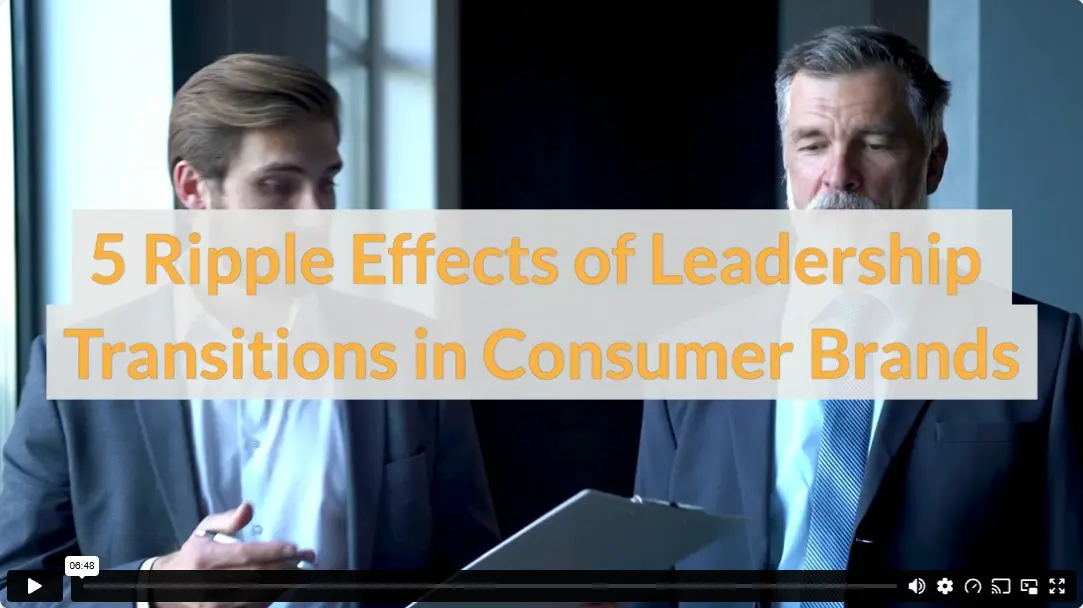
Video
Infographic