When your new manufacturing leader steps into their role, you want to see results almost immediately. That’s understandable. You’ve made a significant investment in a search and a hire. Plus, you need someone to improve your production metrics and close efficiency gaps. Visible results are confirmation that your hire was the right one.
But this pressure is also one of the most reliable ways to limit what your new leader can accomplish. Here are three reasons your next manufacturing executive needs more time to deliver impact and what you can do to get the most from a new hire.

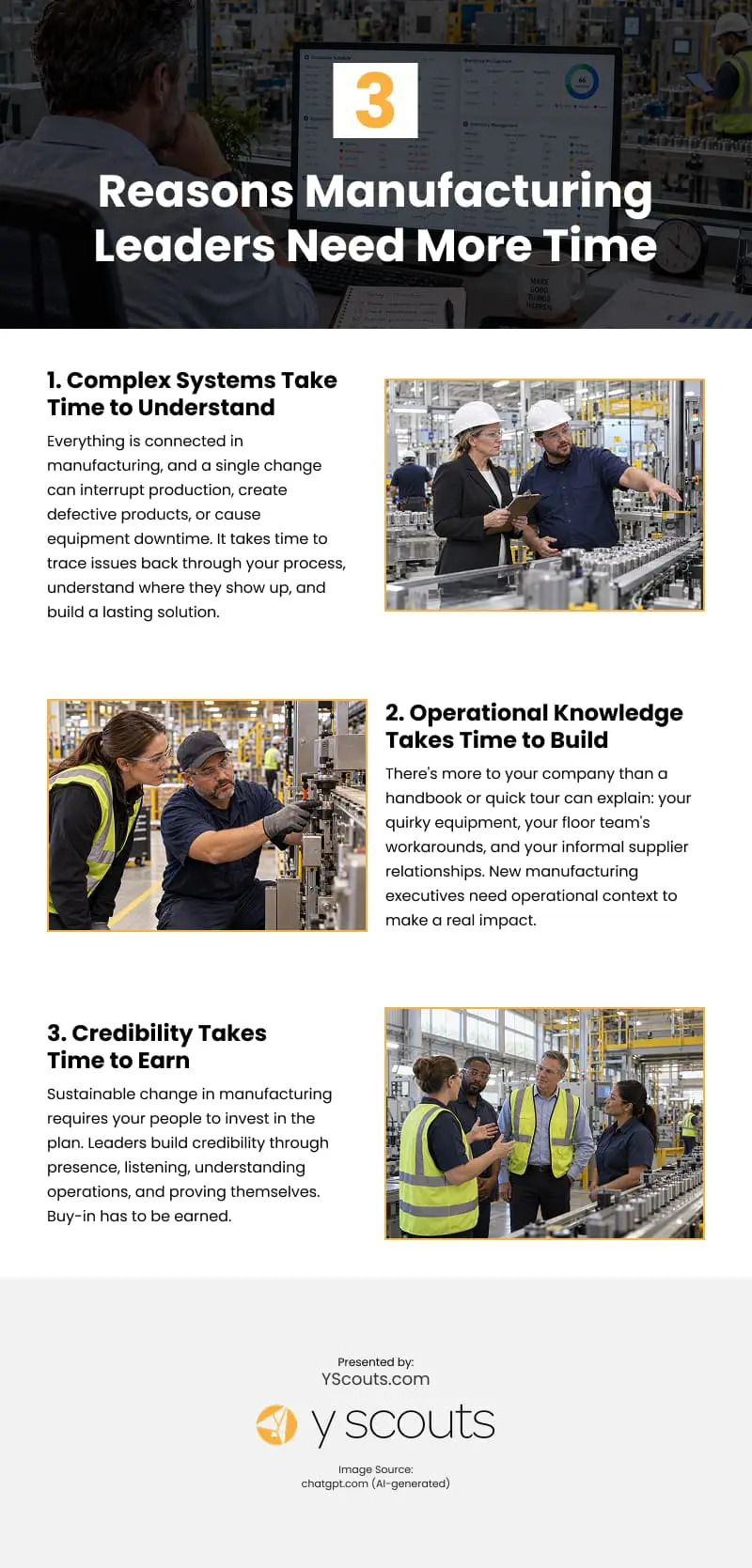
1. Complex Systems Take Time to Understand
Everything is connected in manufacturing. Your operations build on individual systems and processes, which you develop and refine over the years to work together. A single change in your network can interrupt production, create defective products, delay orders, waste expensive materials, or cause equipment downtime.
This complexity is a challenge for leaders who feel pressure to make visible progress. It takes time to trace issues back through your process, understand where they show up, and build a lasting solution. An executive who pushes for visible improvements might achieve them in the short term, but it usually requires another fix six months later.
The connections in manufacturing also mean that new leaders can’t just experiment. A single change impacts your entire system, and a single disruption can swallow your profit margins. Pushing newly hired leaders to make changes right away puts your whole company at risk.
Say you hire an IT executive search firm to hire someone who will modernize your company. You are very excited about your hard-charging hire who quickly replaces your production scheduling software. But because they acted before they fully understood your setup, the new software doesn’t integrate with your other software and systems. This change costs you the upfront price tag and training, as well as wasted materials, overtime, delivery delays, and lost contracts on the back end.
2. Operational Knowledge Takes Time to Build
Most onboarding processes consist of sharing official manuals, org charts, handbooks, and other paperwork with the new executive, showing them around the plant, introducing them to a few people, and hoping they’ll figure it out on their own. But there’s a lot more to your company than can be explained in a single handbook or on a quick tour: your quirky equipment, your floor team’s workarounds, the informal supplier relationships, and your unwritten process for making expedited decisions.
There’s a distinct gap between your operations and your onboarding. And pressure to deliver quickly disregards that learning curve. You’re not driving change. You’re forcing leaders to act before they’re ready, and that can produce decisions that fall apart.
Say your new VP of Manufacturing increases the operating hours of a production line, but the line is still falling short of its targets. It’s a solid plan on paper. But your VP didn’t know that your engineering, maintenance, and production supervisors use informal workarounds to manage equipment limitations and prevent quality issues. Once the new plan eliminates those workarounds, equipment failures, quality problems, and downtime increase.
Leaders who immediately drive change, even when it looks right on paper, can create friction within your operations. New manufacturing executives need operational context to make a real impact, and that context takes time to develop.
3. Credibility Takes Time to Earn
Sustainable change in manufacturing requires your people to invest in the plan. Leaders can only inspire that kind of buy-in when they’ve built credibility with your floor teams, so those teams believe in the plan and trust the leader enough to make changes.
Leaders build that credibility through presence, listening, understanding operations, and proving themselves. This takes time. A new executive who feels pressured to deliver results can’t spend their first three months visible on the floor, asking questions and building relationships. They have to arrive with a plan and drive implementation from the office to boost quarterly metrics.
Moving fast means your new hire moves without credibility and without buy-in. They might produce short-term results, but it’s at the cost of organizational norms and team satisfaction. You often see long-term disengagement and leadership turnover in the months and years following changes that were made quickly rather than credibly.
The leaders who deliver real impact in manufacturing don’t move more slowly due to a lack of urgency. They move deliberately because they understand that sustainable performance requires the team’s buy-in, and buy-in has to be earned.
Give New Leaders a Clear Path to Impact
A new hire still needs defined success outcomes, and you still need timely improvements at your company.
Manufacturing executive search firms recommend that you give your new hire a longer ramp-up timeline defined with explicit milestones. This strategy satisfies your need for confirmation that you made the right hire. It also puts the leader on a path to sustainable success.
The key is to consider what the leader needs to do early on to deliver real impact. And you can’t tie all the success outcomes to your production output. Your new hires need to learn processes, build relationships, understand culture, analyze problems, and brainstorm solutions before they can drive changes.
Say you work with a deputy CEO executive recruiter to hire a second-in-command who can increase production at your manufacturing firm with your current facilities, equipment, and workforce. A long and clear transition from the hiring expert might look like:
- First 30 days: Observe how work actually gets done and identify where teams encounter bottlenecks.
- 60 days: Analyze production data to identify the biggest constraints.
- 90 days: Establish baseline production metrics, present findings to the board, and recommend a focused plan to increase output with existing resources.
- 120 days: Test one or two improvements on a limited production line or shift and measure the results.
- 6 months: Adjust the process based on trial results and address any problems that surfaced during trials.
- 9 months: Expand successful changes to additional lines, shifts, or facilities, and establish systems to maintain the gains.
- 18 months: Evaluate performance against the original baseline and demonstrate to stakeholders that the operation can produce more with its existing resources.
This timeline considers what new executives need to understand, who they need to know, and what they should assess in the first few months with your organization. It gives the leader a clear path without pressuring them into reactive decisions.
A new manufacturing executive also needs a channel for flagging where in the organization they have questions or need more context. Otherwise, you’re waiting for your output metrics to surface problems, or for their failure to do so. Build honest, ongoing communication into the transition timeline so they can make better decisions and meet their milestones.
Position Manufacturing Executives for Success
Manufacturing leadership is a long game. It took time to build your systems, and it takes your new hire time to understand them. Organizations that give their new executives longer transition periods position them to perform well in the next quarter and make an impact at your manufacturing firm for years to come.
Infographic