It’s easy to expect your Chief Technology Officer (CTO) to solve all your tech challenges. After all, you’d expect your Chief Compliance Officer (CCO) to address all the regulations and audits within your company. Why shouldn’t your tech expert do the same?
The reality is that no single CTO can do it all, and you’re setting your company and your executive up to fail if you expect them to deal with every tech issue. Here are five reasons why that is, and what you can do about it.
1. Tech Challenges Shift Too Often
Twenty years ago, technology evolved in steady, predictable patterns from year to year. CTOs could plan on their infrastructure, software, strategies, and systems remaining up-to-date for five years or more.
If the pace of technology change back then was a car, then today’s advancement rates are a rocket ship. AI developers release new models weekly. Cybersecurity threats happen more frequently and from a variety of sources. Even the cloud iterates so often that just tracking tech changes is a full-time job.
As your tech expert, your CTO should have the capability, experience, and interest to stay up-to-date with some of today’s innovations and incorporate them into your company. That’s the career path they’ve chosen. But they can’t keep up with all the changes in every field on their own.
2. Today’s Tech Stack Is Too Broad
Not long ago, a CTO mainly focused on infrastructure and engineering. Now that technology drives growth and operations in every sector, your CTO has a lot more on their plate. They are expected to understand software development, AI and machine learning, data privacy and cybersecurity, product growth, user experience, and maybe even DevOps.
That’s a wide range of responsibilities, with each area requiring specialized knowledge. And no matter how brilliant your CTO is, they’re still human. A talented executive with a strong product mindset might struggle with security. Or another who scales infrastructure easily might fumble through cross-functional teams.
It’s unrealistic to expect one person to master every responsibility, especially when you combine that vast range of technology challenges with the lightning-fast changes in the industry. Relying on a single leader to address everything can burn out your executive and create gaps in your company’s operations and strategy.
3. Tech Demands Span Too Wide
Even as technology has rapidly changed, many companies haven’t adjusted their expectations for their Chief Technology Officer. So, leaders transition between hands-on work, such as putting out fires and building the system, and executive responsibilities, including leading various teams and shaping their overall tech vision.
When companies ask CTOs to wear so many hats, they’re bound to miss something. And no one can excel at anything if they’re juggling dozens of rapidly changing responsibilities on their own.
That’s why focusing and defining the role is one of the first things CTO search firms do to help companies recruit top talent. When you acknowledge that no one can do it all, you allow your tech executive to positively impact your company rather than running themselves ragged doing mediocre work.
4. Cross-Department Alignment is Too Complex
When the Chief Product Officer (CPO) wants to move fast, the Head of Sales wants new features, the Chief Financial Officer (CFO) wants increased predictability, and the Chief Operations Officer (COO) wants improved stability, they all expect your CTO to have the technology and strategy to make it happen.
But you don’t have a fix-everything app in your tech stack, and your CTO is not a magical unicorn. Addressing tech challenges across departments always takes significant time and energy, and usually requires complex knowledge and approval.
Say your CTO decides to tackle the new product features the sales leader requested. The product department relies on engineering, which in turn depends on the data team. Your tech expert has to unravel three layers of workflows to begin making adjustments. And even then, your CTO needs approval from the heads of each department to initiate changes.
With technology at the heart of every department and every company initiative, one leader cannot navigate all the different aspects of the business or handle all their tech challenges.
5. Scaling Companies Grow Too Quickly
As your company grows, so do your tech needs. What worked when you had a single engineering team starts to fall apart once you’re operating across multiple markets, teams, customer segments, and products.
Many companies continue to pile responsibility onto their CTO’s plate. Then the tech expert either burns out or becomes a bottleneck. So now you’re reacting to problems instead of planning for the future.
Instead, start thinking now about how to distribute leadership and plan for growth. Even if you’re still small, laying the foundation for a scalable tech team will pay off in the long run.
A Better Approach: Team-Based Leadership
Let’s be clear: you still need the CTO role in your C-suite team. But they shouldn’t be the only tech expert in your company. Surround them with other strong leaders who complement their skill set.
Think of it like a band. Your CTO might be the lead guitarist, but you still need a drummer, a bassist, a sound engineer, and backup dancers to run the rock concert. Everyone plays a part.
Here’s how to get started building a team-based approach to technology.
Understand Your Gaps
A good first step is to assess where your tech department is showing strain. Figure out if you’re demanding too much of your CTO by asking:
- Are tech issues slowing down projects or creating bottlenecks?
- Does your CTO personally solve every major tech problem?
- Is your company struggling to integrate newer areas, such as AI or product growth?
- Does your leader spend more time reacting than planning?
- How many technology specialists have you hired?
- Are tech expectations between marketing, sales, and product teams misaligned?
- Have you changed CTOs frequently?
If so, these are sure signs that you need to expand your tech leadership and rethink the CTO’s role. These questions can also help identify areas where you can effectively change your leadership structure and better support your current executives.
Change Your Leadership Structure
What does technology leadership look like if you stop relying on a super CTO who can do it all? A team-based leadership structure spreads responsibilities across multiple roles, both existing and new. This approach might look like:
- A VP of Engineering who handles architecture, dev teams, and delivery.
- A Chief Product Officer (CPO) who owns user experience and growth.
- A Head of AI or Data who focuses on advanced technologies and compliance.
- A Director of Security who manages cybersecurity and risk mitigation.
- A Fractional CTO or Advisor who fills strategic gaps on a part-time basis.
This structure brings balance and depth by allowing each leader to focus on their strengths and handle complex challenges more efficiently. A team-based model also provides your company with greater resilience. If one leader leaves or shifts focus, the rest of your tech leadership can pick up the pieces.
Partner with CTO Search Firms
If you’re unsure how to start your new approach to tech leadership, consider partnering with an executive search firm. The best IT recruitment agencies help you structure roles and recruit talented candidates based on your goals, industry, growth stage, and technology needs.
Maybe you don’t need a new CTO. You may need a Chief Information Officer (CIO) to focus on your internal IT operations, while your current executive concentrates on developing your product and scaling your systems. A CIO executive search firm could help you divide the responsibilities and find the right leader to add to the team.
Just like you can’t expect your CTO to solve every challenge, you don’t have to change your company’s leadership on your own. Retained executive search firms act as long-term partners to support your C-level hiring strategy and your company’s future.
An Approach for the Real World
It’s tempting to look for a unicorn CTO, but it’s not realistic or sustainable in today’s tech world. So it’s time to step out of the fantasy world where a single tech leader can handle it all and build a team-based approach to leadership that positions you for success in the real world.
Video

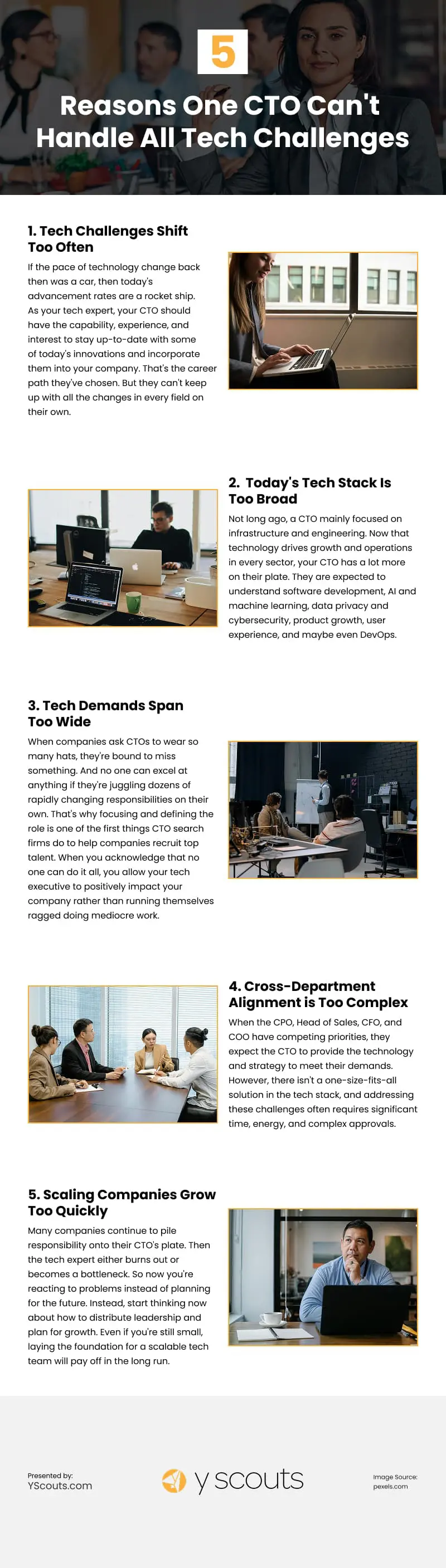
Infographic
Many organizations expect a Chief Technology Officer to handle every technical issue, much like other executives oversee their domains. But this assumption sets both the company and the CTO up for failure. This infographic explains why no single leader can manage all technological challenges alone.